Email campaigns: successful and secure through SPF, DKIM and DMARC



There was a time when we felt a little more secure when it came to the spam and email spoofing we were experiencing daily. Internet crime is on the rise and new malware helps scammers launch ever more sophisticated hacking attacks on email accounts. Moreover, all sectors and industries are now affected, from small SMEs to large corporations. Proven solutions such as the use of SPF, DKIM and DMARC are intended to help prevent cyber attacks via emails in the field of IT security.
Thank you for reading this post, don't forget to subscribe!
Before we get into the details of the three methods for combating spam, it is important to understand the vulnerability of emails. Email messages contain two sender addresses:
The «Envelope From» address is the return address. This tells the email server where the message should be sent back to. This address is hidden in the email header, which also includes further technical details. The «Header From» address is the one that you see in the «from/from field» in your email client as an email user. Both addresses can be easily spoofed by spammers and cybercriminals.
SPF is an authentication protocol that allows the owner of a domain (e.g. @Intecso.ch) to define email servers that are allowed to send emails on behalf of the domain (e.g. @intecso.ch). Examples of these are email servers from Office 365 or cloud newsletter tools.
The owners of the domain publish the email servers in the «DNS SPF Record». The receiving email server checks this DNS SPF Record to see whether the sender’s email server is allowed to send the email from this domain. If this email server is not found there, authentication fails.
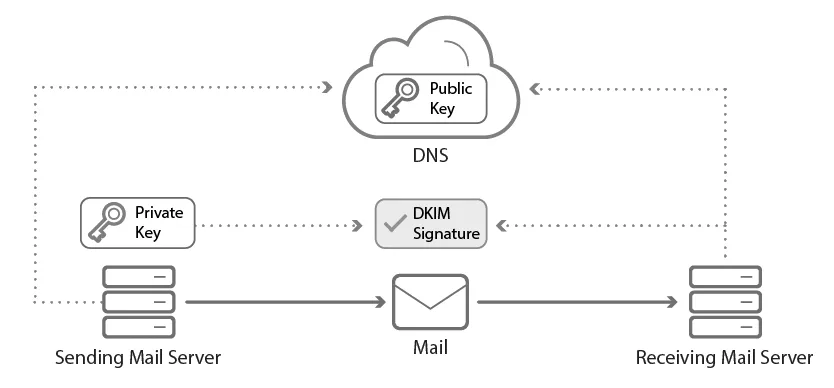
DKIM is a mechanism that enables your IT security to achieve higher trust in email accounts. Validation is ensured through cryptographic authentication.
DKIM checks the email domain of the sender address. Unlike the SPF method, the IP addresses of the servers are not compared with DKIM. To ensure authenticity, the message and the mail header are digitally signed. To do this, a private key and a public key are generated on the own mail server, and the public key of the domain is attached via a DNS entry. This gives each email a signature calculated specifically using the private key, which is then compared by the receiving mail server. If the verification on the recipient mail server is positive, this proves that the incoming email was sent from a correct mail server.
«Envelope From» domain @ich-bin-böse.ch (DKIM record was created for this domain by the attacking side) «Header From» address @ich-bin-gut.ch (the recipient feels that the email was sent from @ich-bin-gut.ch)
Here, SPF and DKIM are combined. This ensures that the email has been validated using SPF and DKIM standards. The «From» header and the «Envelope From» address are also compared. The two key values are Domain Alignment and Reporting.
DMARC ensures that the «From» header address (the visible address in the email client) has not been falsified.
As with SPF and DKIM, a DMARC DNS record is created by the owner of the domain. Here, the owner can instruct the receiving email servers how to handle emails that do not pass the DMARC check.
Email providers regularly send reports back to senders to provide insight into which messages have been properly authenticated, which have not, and why. DMARC is the first and only widely used technology that can make the «From» header address (which users see in their email clients) trustworthy. This not only protects customers and the brand, but also deters cybercriminals from pursuing a brand with a DMARC record with less likelihood.
Despite all precautions, always be vigilant against cyber attacks of any kind. Even if you have taken all security measures and configured them, the sender of a message can still have been hacked. Therefore, if you are unsure, please have the sender’s address professionally verified for its trustworthiness. Would you like to make your daily email communication and campaigns safer? We support you competently and transparently regarding DKIM, SPF, and DMARC, and look forward to your contact for a free consultation.